
"Cross the Wannies" by guest writer Janet Hardie
Janet Hardie tells the story of a group of friends living in the valleys and hills of rural Northumberland who came together over 30 years ago to share their love and enjoyment of traditional music. At that time, Alastair Hardie was the only musician in Coquetdale in the group. They mostly met in each other's homes in West Woodburn, Ridsdale, or beyond Otterburn.
This article first appeared in issue 182 of The Northumbrian June/July 2021.
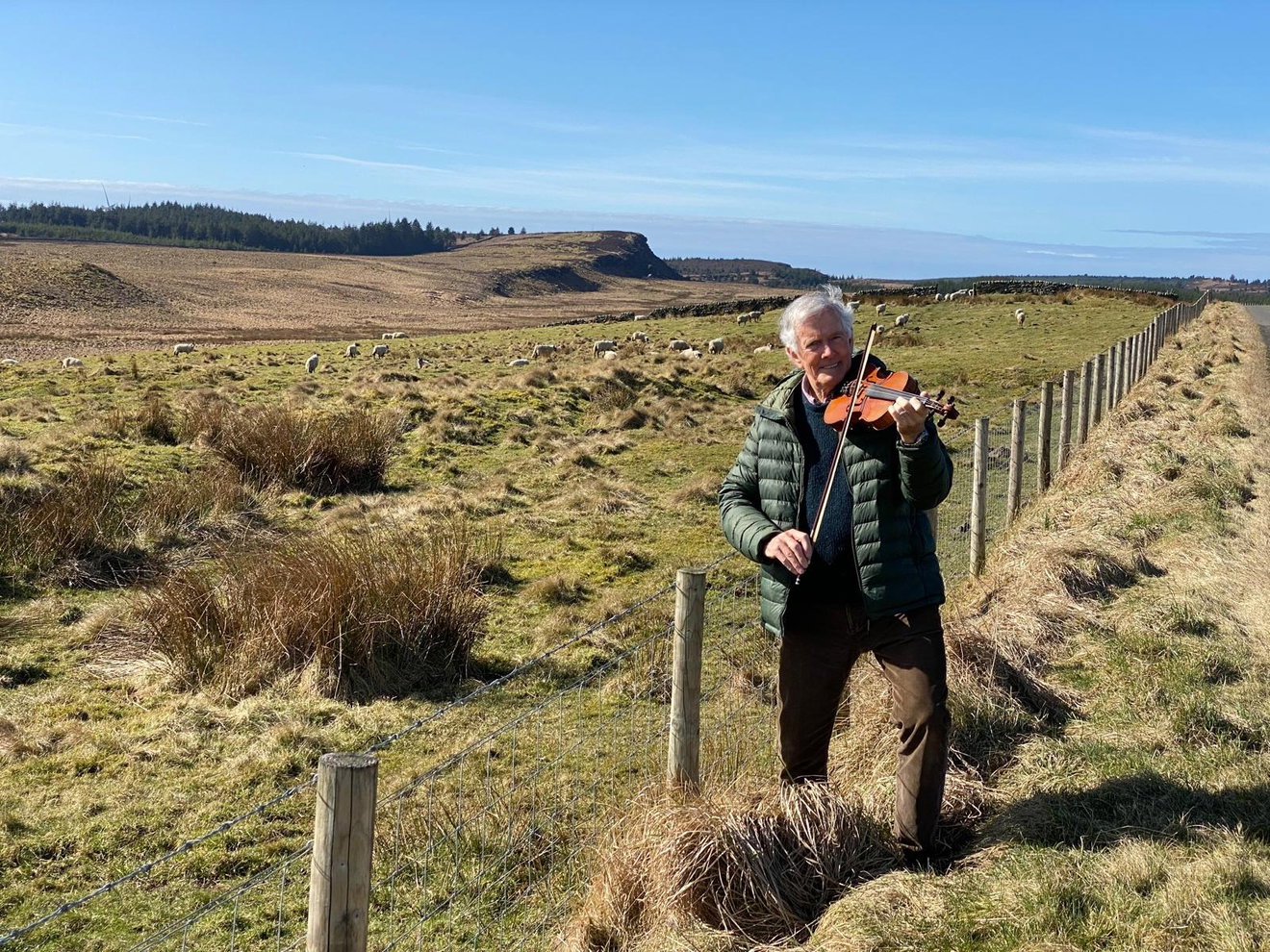
Alistair Hardie on the fiddle, The Wannies.
In earlier years much of the entertainment in this area came from dances and informal music held in village halls and pubs. It was a way to see friends, have a romantic fling, and even meet future partners, as well as have an evening of traditional country dancing. Each community would have had their band ready to make music whenever the chance arose. Sometimes shepherds and hill farmers, who had entertained themselves in the long winters by playing their instruments, would showcase their tunes.
I was lucky to have been influenced by this music as much of my childhood had been spent hearing the tunes played by Jack Armstrong of ''The Barnstormers" fame, and my mother, Patricia Jennings, on the Northumbrian small pipes.
For the latter part of Patricia's life, she held a monthly gathering for pipers in her flat at Wallington.
Whenever I visited her, I loved to listen to the group - it was always uplifting yet nostalgic at the same time and it seems the music is embedded in my bones.
Now I feel my life has come full circle, as I returned to the county seven years ago when I married Alastair. Music is central to my husband's life and I was immediately swept into a circle of wonderful local musicians. The camaraderie was amazing, the tunes flowing along, with a bit of banter here and there, and gradually I got to know the players and heard their stories.
Some 30 years ago Nairne Cross, who lived in West Woodburn, invited a handful of local friends to join her to make music. Nairne was Scottish with close connections to Shetland and its fiddle music. Like her, most of the musicians she knew had heard and absorbed such music from a very young age.
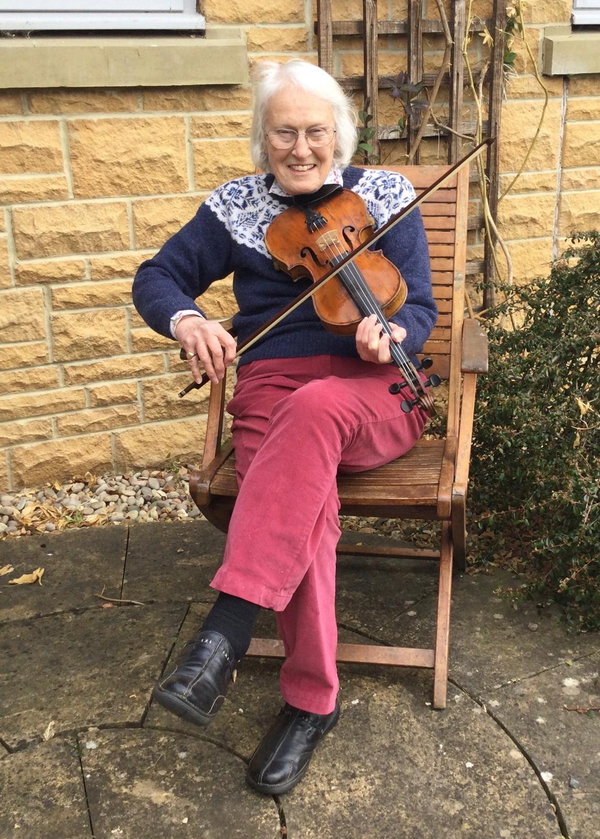
Nairne on the fiddle
Nairne's friends so enjoyed their initial get-together they agreed to meet regularly in each other's homes, every Monday. The gatherings rotated round six or seven houses all in deeply rural countryside.
If not at Nairne's farmhouse, they would meet at the homes of the other group members, including Ian and Betty Scott's farm, Catcherside, on the Wallington estate, and also the home of the artist Mary Ann Rogers in West Woodburn.
Occasionally they played in a quirky location, such as the Punch Bowl rock on Shaftoe Crags.
Most of the players had to drive either east or west across the Wannies - an outcrop of hills, rocks, and wild moorland and not a place to get stuck in a snowstorm - so they eventually named themselves “Cross the Wannies.”

One important aspect that features large in the memories of the musicians in those early days was that in true farming tradition, a delicious spread of scones, cakes, and biscuits was laid on by the home bakers.
This was always the time for a good craic and a chance to catch up with local news as well as having a feast.
The evenings were unstructured and informal, as they still are. The fiddle, mouth organ, and accordion were very much at the core of traditional music, and Nairne, Phil Armstrong, and Alastair Hardie all played the fiddle. Phil, a teacher, had been playing since he was seventeen and describes the music making:
“just brilliant, the musical connection is tremendous, challenging at times but always enjoyable. When we are playing there's no thought of other things, just immersion in the notes and thinking ahead to the next notes or phrases. Every night is different.”
Alastair loved all the Northumbrian dance tunes he had known since childhood and went to the local dances whenever he could - in fact, that was where we had first met in our teen years!
He has a very good musical ear and found the weekly evenings of music became an important part of his life, making a relaxing break from his work as a potter.
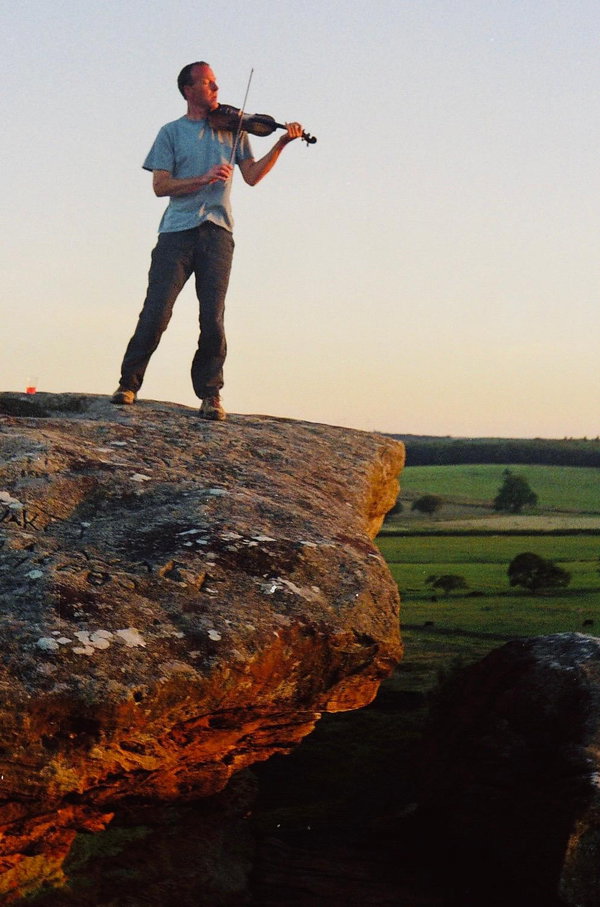
Phil Armstrong on fiddle
Ian Scott's contribution to the group is a true gift, and other musicians speak very highly of his talent. He is always the leader in an understated and modest manner. He might start off a tune on his accordion - no title or introduction - and other musicians will drift in, sometimes with harmonies. Or someone else would play a phrase and Ian would be the first to pick it up, however hesitantly it was played. No words would be spoken - just listening and playing. He also composed numerous tunes.
Phil says Ian's tunes:
“will stand the test of time. They will live on, as markers for events, places and people.”
The foreword to one of Ian's tune books says,
“Ian is a rare example of a natural musician who has the skill to turn people and events he encounters in everyday life into tunes which are truly Northumbrian in style. In playing them you will feel, and be able to share Ian's love for, the beauty, moods, history and traditions of Northumberland”.
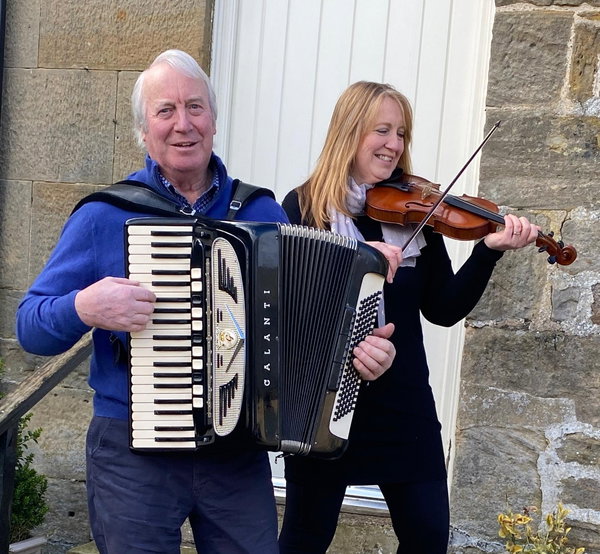
Ian Scott and daughter Sara
Besides Nairne, Phil, Mary Ann, Alastair, and Ian, other founder members of the group included Sara Forster, daughter of the Scotts, Derek MacDonald from Ridsdale, Kit Pumphrey from Bolam, and Alan Nichol from Warksburn.
Of course, no music group in this county would be complete without the small pipes. However, the standard pipes are not in the right key to play with other instruments, so the chanter has to be adapted to G.
This did not deter Kit Pumphrey, and Ian wrote a charming tune called 'The Happy Piper' describing Kit who
“perseveres with a smile playing the G chanter which he finds difficult to play. Happier playing in Wallington pitch.”
Kit's recollection of his first visit to the group was nine-year-old Annie (a future concert pianist) trying to teach him to play the spoons, without success.
Another well-known piper, Andrew Davison, chair of the Northumbrian Pipers' Society, now plays with the group and has also had to convert his own pipes to the right key.
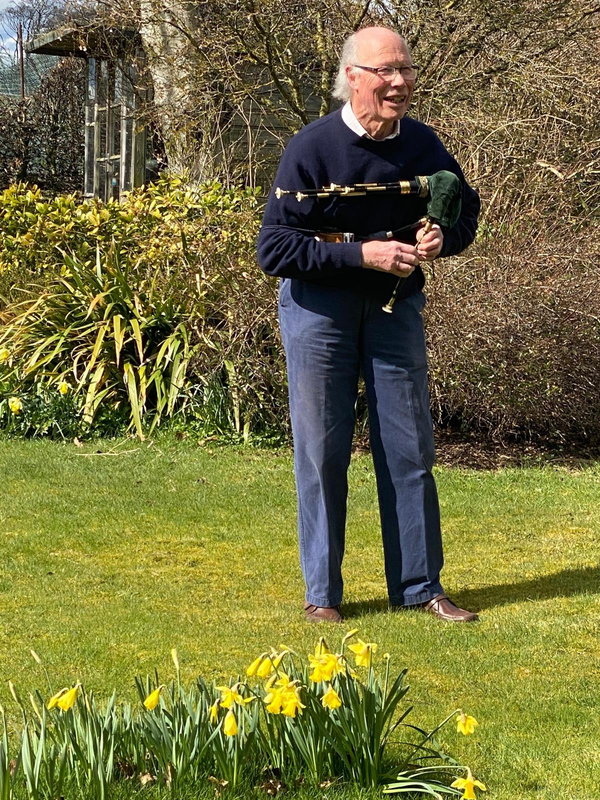
Kit Pumphrey on the Northumbrian small pipes
Knowing how important it is to hear and absorb traditional music at a young age, it is interesting to see how it influenced the daughters of Mary Ann Rogers. At the time of the group's formation, she played the 'cello and would always take her two young daughters, aged 11 and 9, to the sessions, insisting they had to do their homework during the music making.
It must have had a profound effect on her girls, as they have subsequently become professional musicians. Annie is a classical pianist and Ruth carries on the traditional folk music with her fiddle.
Other talented young musicians have joined the group and moved on. One young piper even had a tune named for him - "Jack's Chips!" After performing he would make a beeline for the chips kindly provided by the pub.
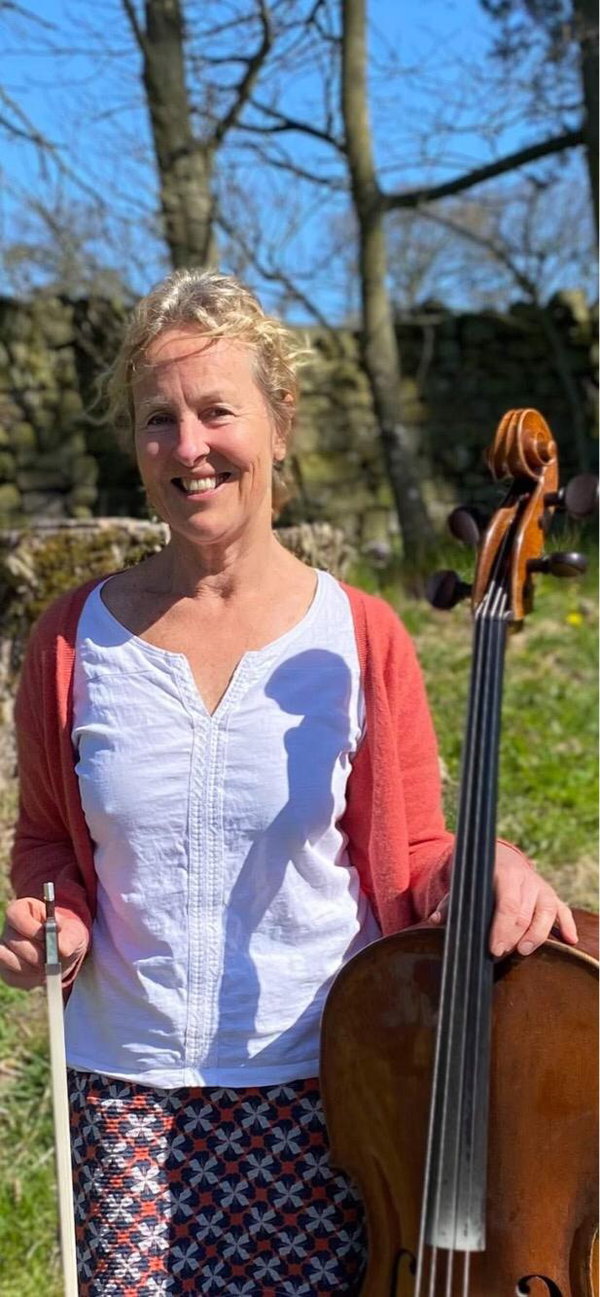
Mary Ann with Cello
The “mouthies” (mouth organ/harmonica players) are an essential part of the Northumbrian music-making scene. Alan Nichol is an accomplished mouthie with a remarkable, foot-tapping rhythm learnt at dances from a very early age.
Whether waltz, reel or hornpipe, the music is always irresistible to those who want to dance. (He admitted that was where he met his wife, Mandy, many decades ago). The original mouthies, Alan and Derek, with the later addition of Jimmy Little, have traditional music in their blood, playing the phrases and grace notes instinctively.
Not so long ago eight mouthies were playing in a pub and the question went round the circle - “What do you call a group of mouthies?” There were some wicked offerings!
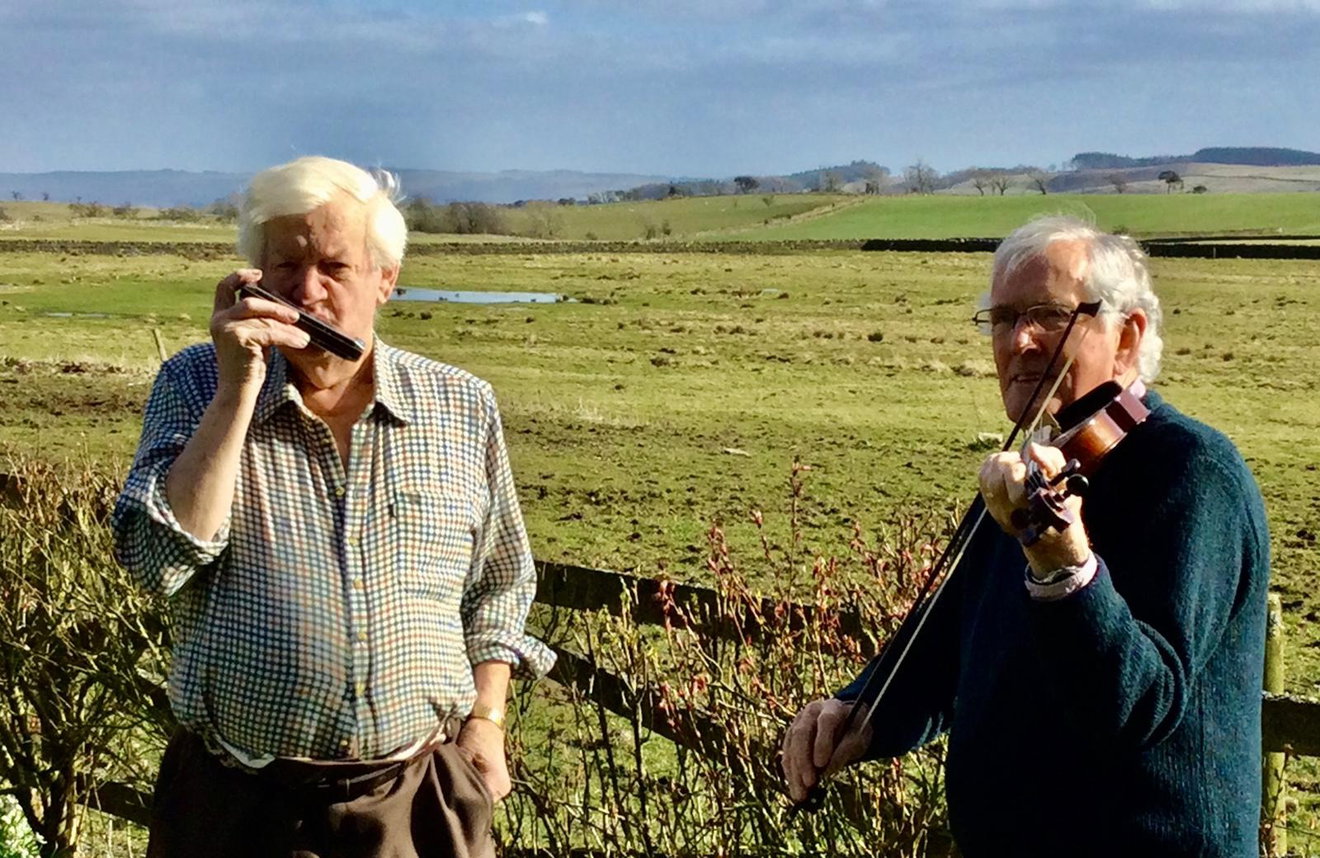
Mouthie Alan Nicol and Alastair Hardie
Mouthie Don Clegg, born in Rochester, Redesdale and now living over Keilder way, has also brought with him a wonderful gift for recitations in broad dialect. Often during a pause in the music he would read a piece from his favourite book - “Geordie Broon of Backworth” or even one of his own poems, and have the group in stitches of laughter. When asked for a suitable musical quote for this piece his reply was:
"Aa'm pleased to play music whenivvor Aa'm asked,
but ye canna blaa the moothie when yor wearin' a mask! "
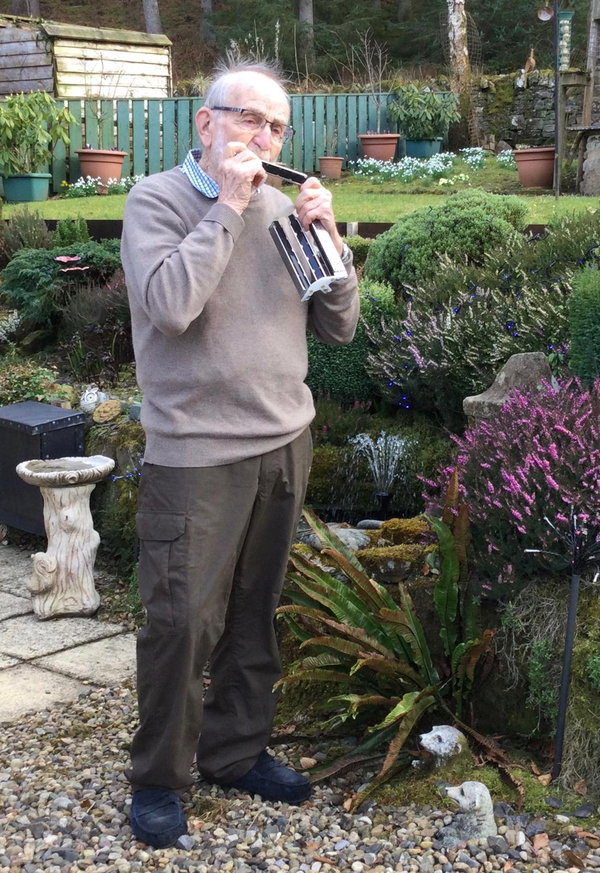
Don Clegg with mouth organs
Composition of tunes takes place all the time. Individuals in the group would feel very special if Ian wrote a tune about them and he would often add a descriptive comment. A particularly poignant tune by Ian was called 'Silent Spring'. “This one speaks for itself - after the outbreak of foot and mouth there were many who had to suffer not only the loss of their stock but the ever-lasting silence.” Ian, Don, Alan and Roy Hugman all have tune books to their credit.
Kathy Anderson, who comes from a farming background, knew of the group through family connections and was a welcome addition. She is a professional musician and teacher with a classical training and it took her a while to learn the tunes as the playing was all by ear, with no sheet music.
Initially, she brought her keyboard to sessions to vamp and play chords.
“As a music teacher, I could not help commenting on various musical points - and my advice was received generously! The raw natural style is important in traditional music so I've always tried to simply 'tidy up' on the technical side as well as adding and encouraging harmonies.”
Cross the Wannies used to play at fundraising events across the county ranging from Falstone and Bellingham in the North Tyne to Newbrough and Langley in the South Tyne. Alastair comments that the concerts "sort of happened", without much planning or leadership but on the night they always went down very well and the group was delighted by the popularity of their music.
However, on one occasion, when playing at a local care home, the residents were asked what tune they would like to be played next. An elderly man shouted out “Nowt” so sometimes their music was not always appreciated.
Perhaps the highlight came when Cross the Wannies were asked to perform at a fundraising concert at The Sage Gateshead in November 2005. They initially thought they were to play in the foyer, but suddenly found they were to be in Hall One, playing to an audience of 2000. This was obviously a challenge. However, with a little bit of organisation and vital help from professional friends, such as Gillian Birnie, they found themselves on the stage.
It was certainly intimidating, initially, but they played their usual set of traditional tunes with aplomb and apparently, the enthusiastic audience did not want them to leave the stage and shouted for more.
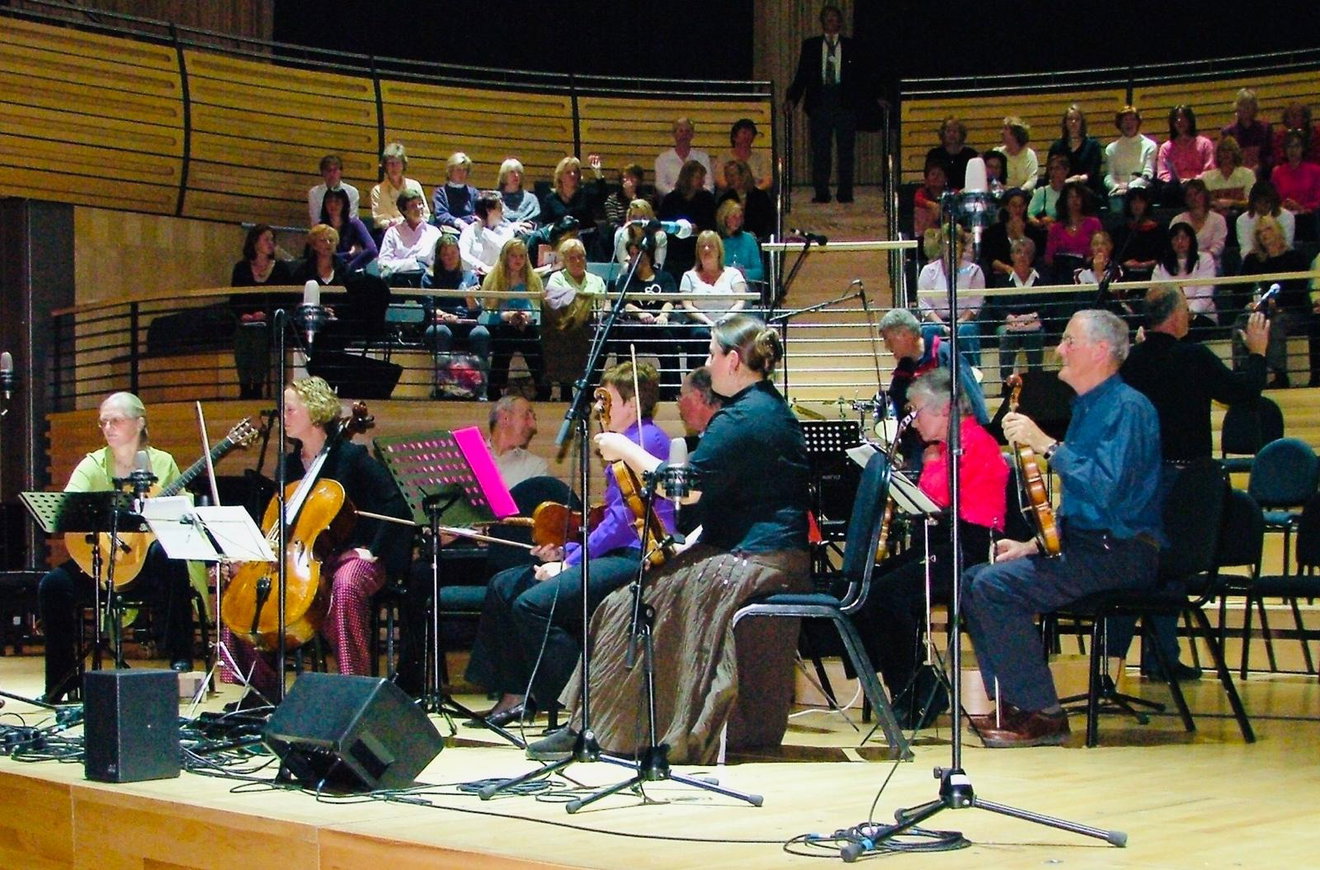
Cross the Wannies at the Sage (Now, The Glasshouse)
Since its inception, numerous fine musicians have been part of Cross the Wannies, and over the years more than 40 have added a variety of musicality and instruments - sadly too many to name here.
As the popularity of the group grew it was no longer possible to meet in each other's homes, so a move was made to meet in pubs or village halls. They had a couple of trial evenings in one pub, but the Monday night drinkers soon made their displeasure known, making so much noise as they threw their darts, that the music was drowned out!
However, they have always been made welcome at the Dyke Neuk, near Meldon, The Gun at Ridsdale and the First and Last/Redsdale Arms near Otterburn.
The original players, some of whom are now in their eighties, look back on those early years with nostalgia but recognise things have to move on.
“There was no politics, just music,” said one player, "there was always a vibrancy about the music with plenty of goodwill and shared friendship which will always be there.”
Cross the Wannies, A Fine Tune
During the Covid years, Roy Hugman, a prolific composer and mouthie, wrote a beautiful tune appropriately called 'Shielding'. It was recorded in a barn with the players socially distanced. You can hear the sparrows chirping in the background and its haunting air captures the sadness and grief of the current pandemic.
Although the pandemic may have temporarily stopped Cross the Wannies getting together, the musicians all know that it is only a pause, and before long they will once again be able to play the music that is so important to them and to Northumberland.
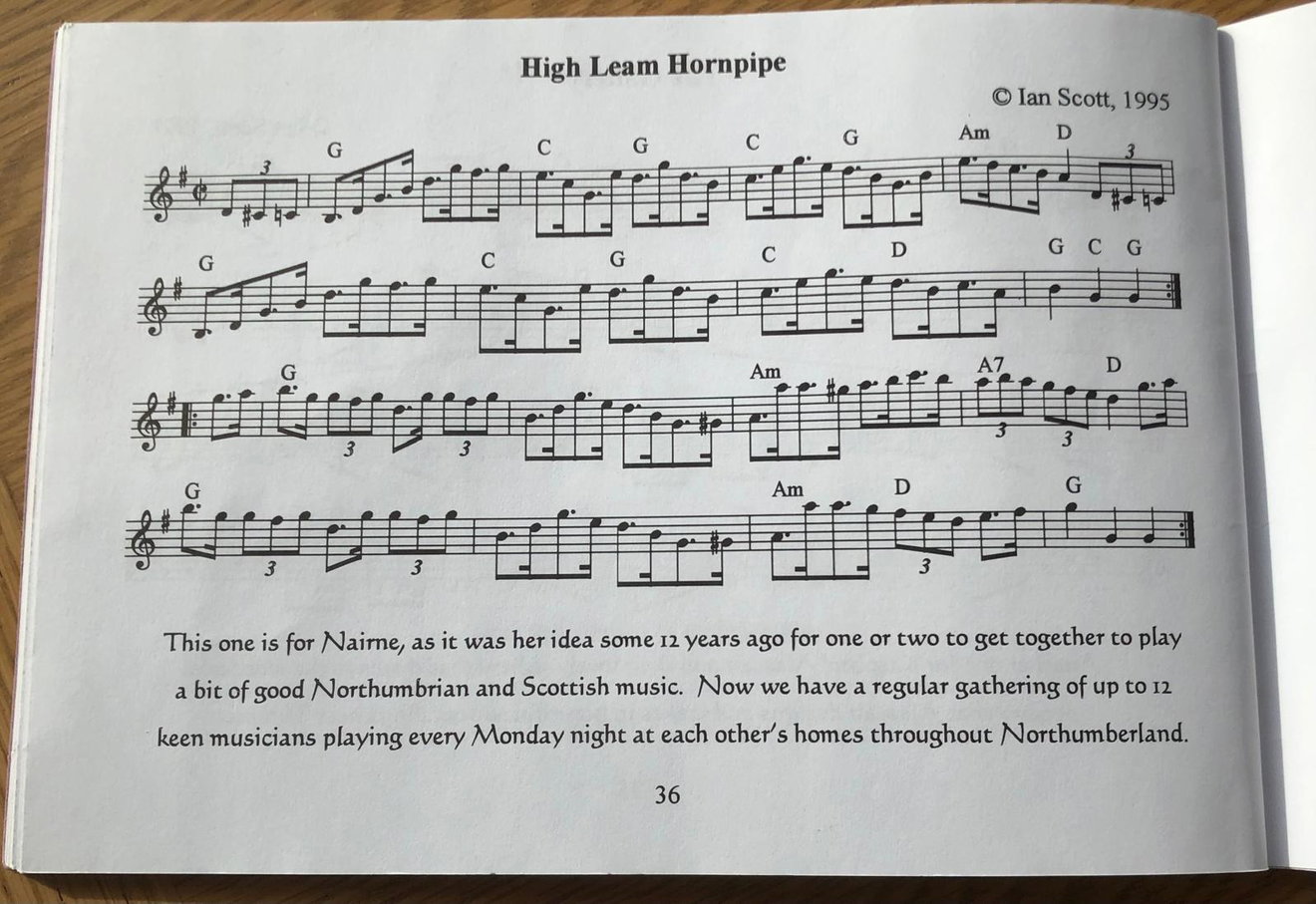
High Leam Hornpipe
Nowadays the group very occasionally comes over to Thropton. And a fantastic new musician has joined, from Harbottle, Elke Meiborg.
You can buy The Lockdown Ledger (Cross the Wannies).
Footnote: I am often asked what instrument I play and my answer is that I am more of a "groupie" but occasionally get a-rattling on the maracas. JVH
Get In Touch
If you would like to be interviewed for Coquetdale Creatives or have some news to share, then please let us know.
Contact Us