
Pat Moloney: Problem-solving fixer of things; creator of 3D Duergar, Red-caps, and other mythological local creatures.
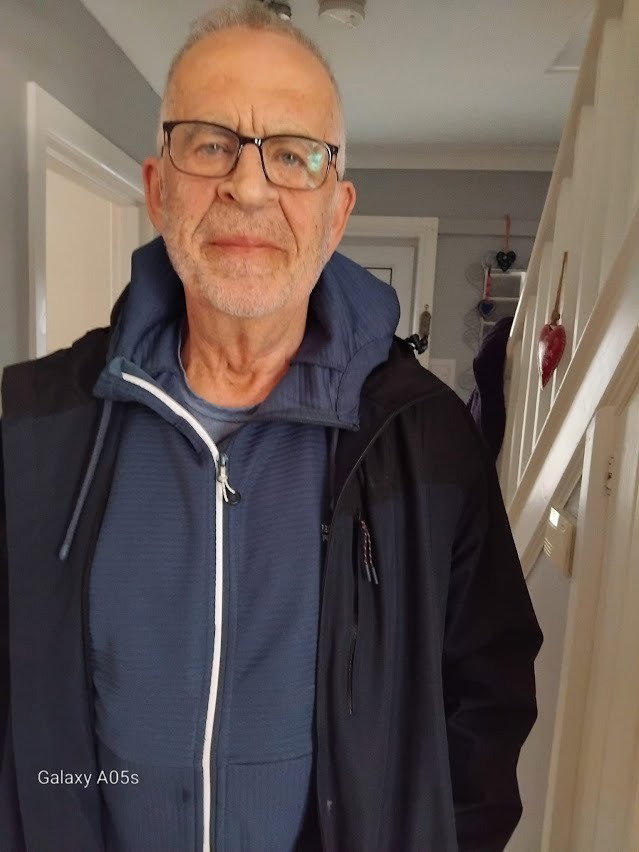
Pat Moloney is a man who sees a problem as a puzzle to solve. He is a maker and mender of things. I have admired his latest creations of local mythological creatures and am delighted to visit his home to learn more about these creations.
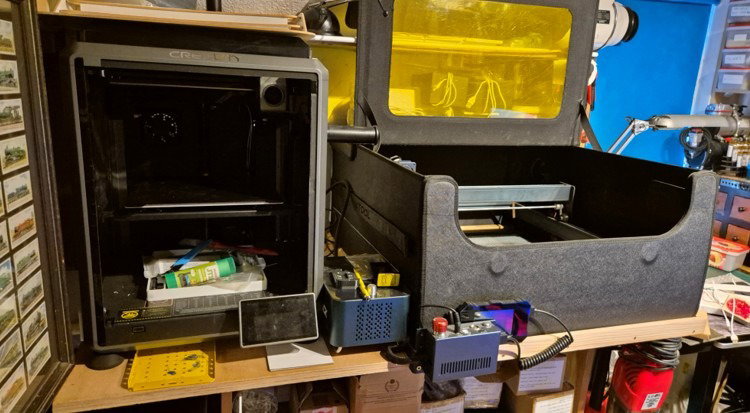
Pat's workshop is a compact space where every inch is used in the most ergonomical way possible. The large screen computer is where his visions are turned into designs. Opposite are two fabulous pieces of equipment - where Pat's designs turn into creations.
One is a 3D printer, and the other a laser printer.
This workshop tells the story of a well-organised, methodical, creative man. Besides the tools of his trade, and all the hardware associated, (neatly labelled, in tidy drawers) and his creations in various stages of production, there is also unrelated, meaningful, artwork. Some cleverly made into the doors of cupboards, others screwed onto sloping walls. It is an Aladdin's Cave of creative industry!
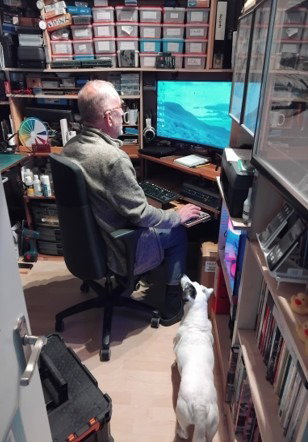
Every bit of space is utilised in a resourceful, ingenious, and organised manner.
Early Days
Pat was born in London, in 1951. As a boy he enjoyed football, but more important to him was the freedom his pushbike brought. He spent many of his days cycling away from home, and back again, exploring the areas around his home in North London. When he had to be indoors his pleasure lay in dismantling things to see how they worked “Not always welcome if the things belonged to someone else!”
Always a reader, Pat enjoyed borrowing his older sister's books, and particularly loved 'The Hobbit', and 'The Lord of the Rings'. He relished the fantasy life depicted, and became immersed in the legendary creatures and world that they lived in.
Working life
When it was time for Pat to leave school, and think about a career, he imagined an outdoor life, measuring distances and angles, feeding his love of geology, and furthering his ability to represent three-dimensional objects. Pat went to college and learned to measure and map, which involved a great deal of geographically-related information. He was studying to be a surveyor.
However, for a variety of reasons, he didn't complete the course and instead his life took a very different turn.
Pat went to work in Camden in a residential home for children. Living-in was a bonus, and the salary was good. Pat enjoyed the work and knew working with vulnerable children was an important role, which he was good at. He eventually made field social work his lifetime career.
Pat recalls a time when it was common for organisations to bring in people to analyse what sort of learner, or worker you are (I can remember this clearly also, I tell him, it was quite the fashion of the time in the 80s). Pat was unsurprised to be categorised by the Belbin formula as a 'Problem Solver'.
Creations and Making
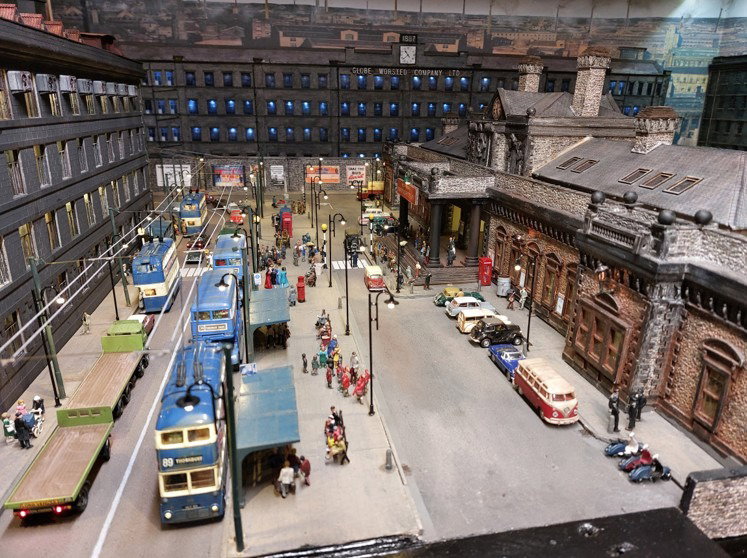
This problem-solving ability and skill, and his love of building things from scratch, has helped with a hobby Pat has had for most of his life. He has built and maintains and constantly improves, a most impressive model railway. Watching this is an immersive experience, as Pat has created an atmospheric little world of sights and sounds from the age of steam trains. This hobby Pat describes as both a “technical enterprise and creative venture”.
“I am the 'Not-So-Fat Controller' - controlling the trains. I get them to stop, wait so long, blow the whistle, before pulling off to the siding, and so on.” What Pat has built is a complicated and intricate set up.
It is very impressive.
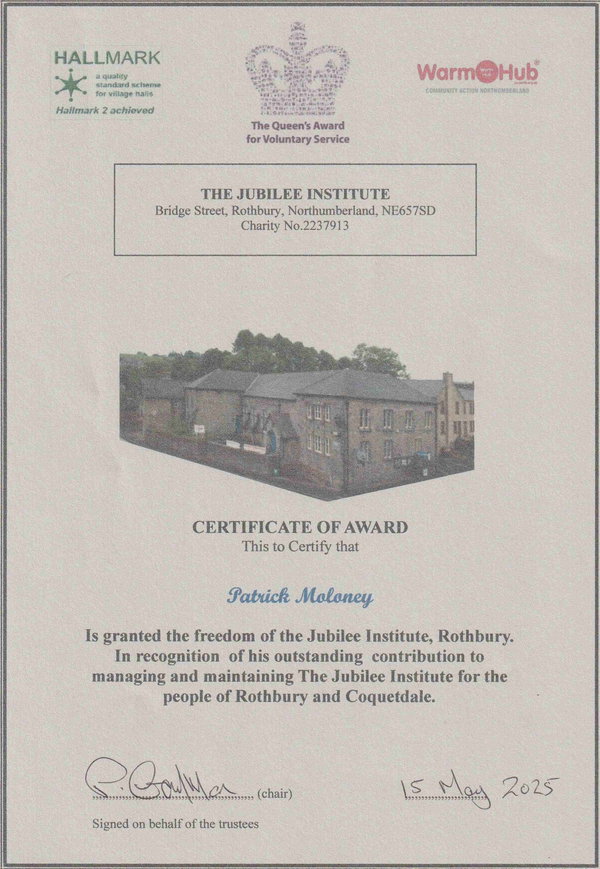
Listening to music has always been a big part of his life, and Pat feels the greatest affinity for the songs and music created during the 60s and 70s. Throughout his life, his sound-systems were always something to be enhanced creatively, and, in 2008, once he and his wife, Pam Moloney (creator behind 'Bagsy') were settled in their home in Rothbury, Pat offered his help to the Jubilee Institute. He served as a Trustee for 14 years, 10 of which as Chair, and looked after the Hall's sound and cinema system during that time.
The Trustees honoured Pat on his retirement with the Freedom of Jubilee Institute.
“I think this gives me a lifetime of access to the Jubilee Hall's toilets, a really important consideration as one gets older!”
Pat's interest in the music of the 60s and 70s, and his enjoyment of researching, culminated in him writing a book (unpublished) about a time when music was an integral part of protest, and musicians were singing about the political world in ways that were very significant.
The book is a thriller, set in the terrifying times of the Vietnam War, the social tensions around sexuality, women's rights, racial segregation. It is a story of the Counter Culture called, “Blues from a Long Day Sky.”
I tell Pat I would like to read it, and ask why he doesn't self-publish, as so many authors do these days.
“It was an important period of time for me,” he explains, “growing up, adolescence, early 20s. I tried to encapsulate that whole period. I did enjoy researching and writing it, but to publish it now would mean a great deal of work, and I am more interested in putting my time into other projects. I also wrote the obligatory Social Work book, sort of autobiographical. A third was started, but there are only so many hours in the day.”
The projects which Pat is really focused on currently are the creations made via the laser, and the 3D, printers.
He shows me a small light box he has made, with a stunning selection of different Lithophanes. The Greek words 'litho' and phainen' combine into 'lithophane', meaning 'to cause to appear'. A lithophane is a thin, translucent plaque, moulded to different thicknesses, which, when lit from behind, forms an image.
Invented during the 19th Century, and made from porcelain. They became incredibly popular. However, by the end of the century they fell out of fashion. Probably with the rise of photography.
Pat has been using his 3D printer to create Lithophanes with a variety of subject matter.
Closing the curtains, Pat turns on the light box to show me.
It is so enchanting!
He displays one which depicts trees. The light can change colour, giving a different feeling to the image. He has a whole handful of different scenes to display.
We both agree they are very relaxing to look at and would make a good night light.
Here are 4 separate lithophanes, with one static as a nightlight of his dog, Alfie.
Slate engraving is a skill which Pat has been teaching himself for some time now.
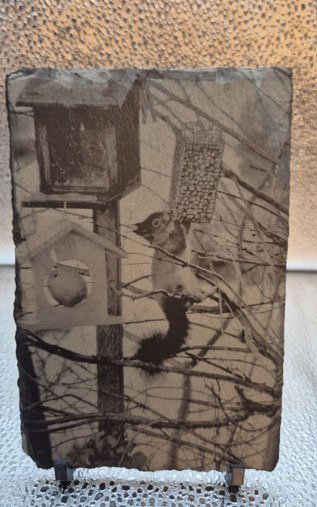
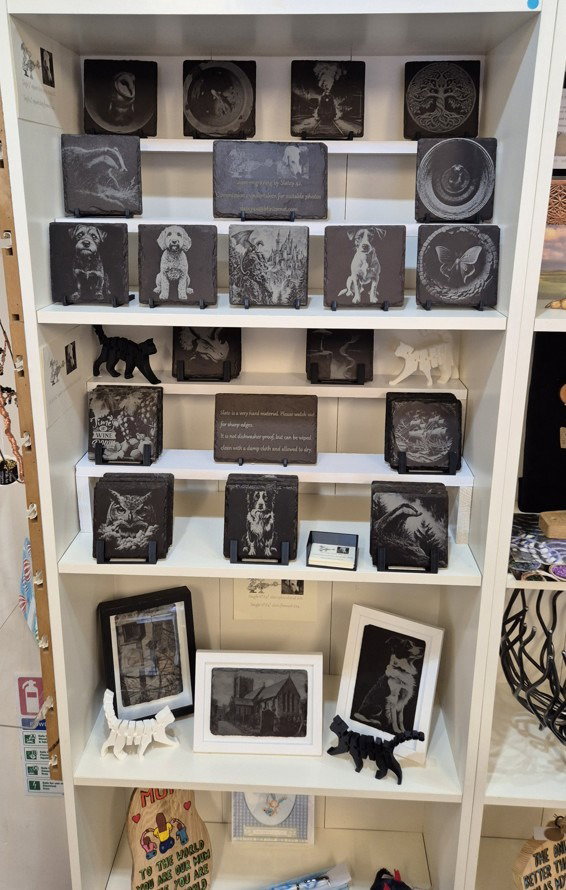
“Purchasing a laser printer led me to use different materials in reproducing photographs, in particular.
I have really enjoyed doing some commissioned work of peoples' pets. I like the effect on slate and am still experimenting with what is the best effect. I think sometimes the material is too dark so not so attractive as, say, a photo.
However, I think it has great potential and I am continuing to work with it.
And the source material is amazingly cheap, especially when you can put an advert on 'Buy Nothing' - or ask a builder if they have any odd bits of slate hanging around, to which the answer is, 'How much do you want?!'”
THE DUERGAR
And then I settle down to learn more about the creation of Pat's Duergar family. Being interested in all kinds of stories, fairy tales, and legends, I am familiar with these local dwarves, and I am greatly fascinated to know Pat's thinking. First, though, I ask about the Redcap he has designed and made.
The Cheviot Redcaps, the Northern Folklore Archive tells us that “Many legends say that these little terrors gathered anywhere 'blood had been spilled or a wicked deed had taken place'... which I'm sure would have been easy to find during the Border conflicts of the 15th to 17th centuries, when these tales emerged.”
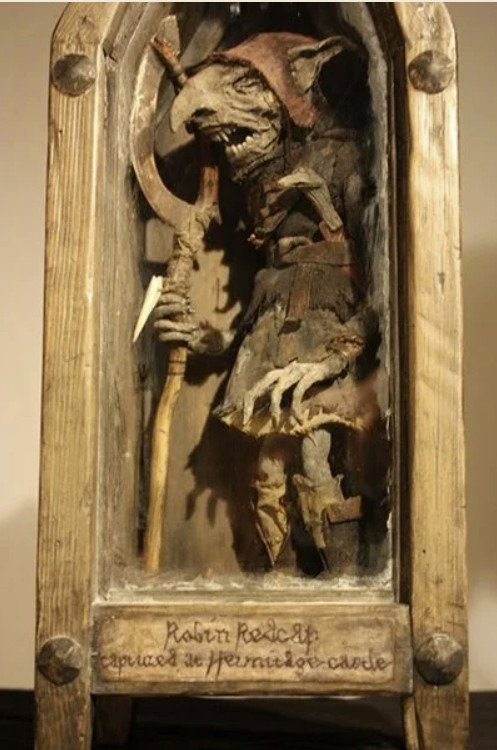
A 'mummified Redcap' made by Jacob Petersson. Photo credit, Northern Archive.
I can see, of course, the clear link with the early escapism to Middle Earth and creatures of that domain, Redcaps, and Duergar.
Middle Earth and its inhabitants have clearly made a deep impression on Pat's imagination, which has lasted his lifetime.
“My sister is seven years older than me. She went on to study Old English/Anglo Saxon at University. She was a great Tolkien fan, and of course he was Professor of Anglo-Saxon at Oxford, before becoming the Merton Professor of English Language and Literature, and a Fellow of Merton College”.
When Pat and his sister spoke about her studies, Pat was fascinated by both the language and the mythologies that she told him about.
“In turn, this sparked a lifelong interest in myths and legends, from Ancient Greece to the present day. At heart, I am a Classicist, the scientist looking at order, balance and structure, but at a deeper level, the Romantic kid still lurks”.
Pat explains that although he had lived in Northumberland since the mid-1970s, it was only relatively recently that he had come across Simonside's Duergar
“Nor had I heard that, in December 2016, an Austrian computer gaming company (THQ Nordic GmbH is an Austrian video game publisher based in Vienna, a subsidiary of Embracer Group) had awarded Rothbury the title of “Dwarven Capital of the World”..
This was in recognition of the Duergar tale, in their view, inspiring both Tolkien, and Walt Disney's Snow White and the Seven Dwarves!
Which in turn inspired the myriad computer games featuring Dwarves, one of which was produced by said computer company.
Now my knowledge of Nordic myths is limited, but I'm pretty sure the Dwarves were causing mayhem well before the Duergar came on the scene around the 11th century? But Rothbury Parish Council apparently has the certificate to prove we were the first!
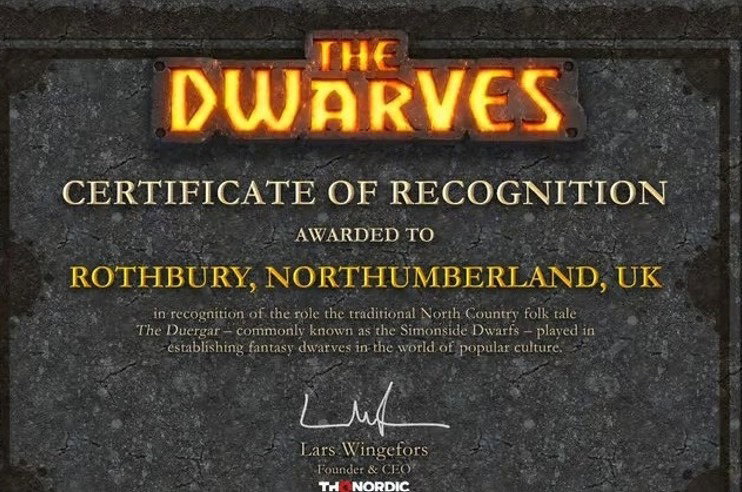
The Northumberland Gazette quotes the then Director of Tourism talking about Rothbury and the Award:
"Jude Leitch, director of Northumberland Tourism, added: "We're delighted to see Rothbury recognised as the Dwarven Capital of the World. Like the Simonside Dwarfs, Rothbury might be small in stature, but it has played a giant part in establishing the fantasy dwarf in popular culture and we look forward to welcoming fans from across the world to Northumberland." (Northumberland Gazette).
Pat tells me more about his feelings about these small, spiteful, creatures.
As a species we are put out by mysteries, we need to see a connection between what happens around us and some sort of explanation for that event. If we can't, then we use our imaginations to fill in the links. In the past, these myths and legends could act also as a warning to others to beware of dangerous places. Or explain the inexplicable. At least we did once: now we use AI to explain everything. And not always correctly. The time of the Duergar had its own round of uncertainties. If someone was lost on Simonside, and just disappeared, then blame the Duergar.
And yet, this reported malevolence of the Duergar really appealed to me. Supposedly lost souls who had not been baptised, these were no Grumpy and Sneezy. They were the real deal. They led we Surface Dwellers to our doom in bogs, or over precipices. Possibly cannibals, they meant business, wreaking revenge on us as pay back for their misfortune. On reflection, I felt they'd had a poor literary deal, and needed some public relations help, so they could take their rightful place in Rothbury's history. But no white wash. They'd earned their place in the moonlight.”
I have read what I can find about the Duergar, and I ask Pat what he knows about them?
“Detailed information is hard to come by, as the Duergar have no written chronicles. So, the challenge to fill in the gaps soon took hold. To help me along, I invented 16 Duergar of both sexes and gave them a particular skill set for increasing we surface dwellers' misfortune. Whilst I am not aware of anyone having been found half eaten on Simonside in the last few years, the Duergar are reported by some to still use their mischief to get their own back on us. (Thank the Northumberland National Park Mountain Rescue Service, and the Park Rangers for protecting us from the worst of the Duergar malevolence).
My take on the Duergar, therefore, covers both the historical and the contemporary. Whether you believe in either, or not, is your choice”.
Originally Pat had thought to engrave his images onto slate. I ask Pat what made him decide to make the creature in 3D?
“I realised that a 2D image on slate wasn't going to really show what was going on in my imagination. These characters needed the colours of the hills, not black and white and shades of grey. Enter 3D printing, and another computer skill to be learned. With my written characterisations fleshed out, I used the computer to draw up representations that I could work on. This took me some weeks, as I got used to using the software to convert the images into a 3D print, but finally I was able to “give birth” to the first”.
“I have used the oldest known tale to describe the Duergar physically, and how they were clothed. Painting them has taken some time, but I am pleased with the results.
Detailed 3D prints cannot be rushed, either in preparation or printing, so I'm unable to mass produce them. Therefore, each one is unique in that my colour scheme is always going to vary with time, especially when I run out of Goblin Green paint!”
I ask Pat to tell me about the individual characters he has created.
“The characters have glaring red eyes, and I have posed them in a threatening manner. I have made 16 of them, including a dog - there was never any mention of a dog - but everyone needs to have one! The names are all taken from Old e English/Anglo Saxon and hopefully typify the characters.
So, for example, the chieftain is Rarian, his name meaning to “Roar”, or “Cry out in Lamentation”, presumably for the lost life they once had on Simonside, before the “Surface dwellers” came and drove them underground.
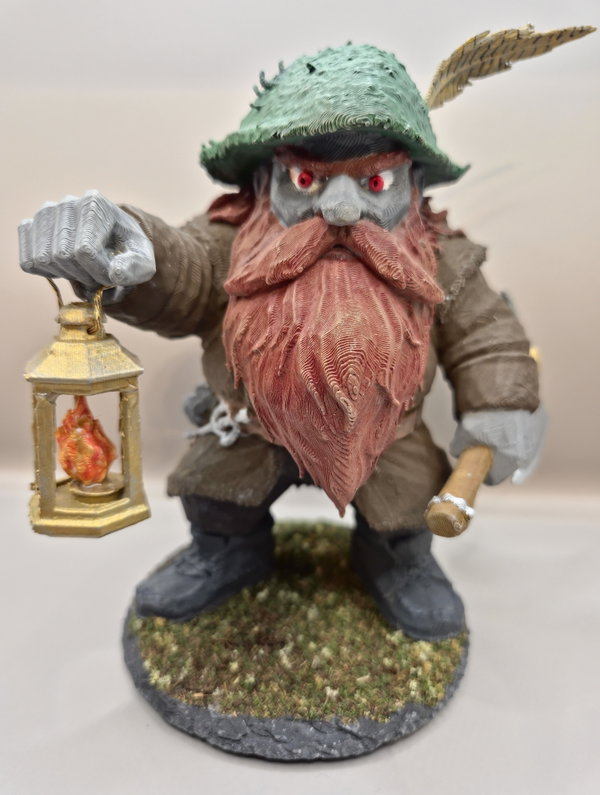
Rarian, the Chief
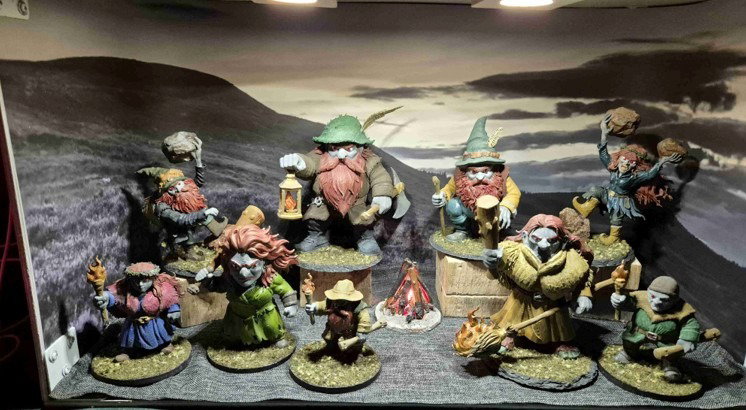
Pat's models of The Duergar (also the lithophanes and slate items) will be on sale in Elements, and the Coquetdale Art Gallery. He has made a Diorama to display the Duergar family in.
He shows me a magnificent photograph of Simonside, which is the backdrop within the Diorama. The family will be placed inside, and the scene lit up, including a flickering fire!
We both wonder why there is not more made of these important stories.
But, perhaps I better leave the last word on this possibility to Pat, the Duergar maker:
“I'm surprised Rothbury hasn't taken advantage, tourist wise, as far as I'm aware, of its standing in the Dwarf world. Without the Duergar, they say, there would be no Dungeons and Dragons.
There is the 'Duergar Night Crawler Race' in February- though it's many years since I could have participated. And I'm not sure the Duergar are too happy with so many people disturbing their territory at night either!
So, if Whitby can have its Goth weekend, linked to Dracula, why don't we have the Surface Dwellers come visit the Home of The Duergar, progenitors of the Dwarves?
Maybe we shouldn't.
Maybe we should just let the Duergar have Simonside to themselves at night in peace, and tolerate their declining mischief by day.”
Get In Touch
If you would like to be interviewed for Coquetdale Creatives or have some news to share, then please let us know.
Contact Us