
Revd Dr Rosie Stacy: Musician and Writer, Educator and Ordained Priest
I wrote about Rosie in 2020, the article was published in the Northumberland Gazette.
Rosie Stacy
Since the interview in 2020, I have got to know Rosie a lot better. She and her husband Graham (watch out for an interview with him, in 2026), moved from Ovenstone, to Rothbury in 2023.
I remember clearly how much Rosie and Graham loved the beautiful home they had there, and the wonderful woodland and gardens surrounding it. Their home for 22 years, I was wondering how much of a wrench the move was? It was, after all, a huge, and stunning, wild and exciting, place, with a large pond, many trees, and different areas of planting.
'Yes', Rosie said, 'But Storm Arwen changed all that'.
Many of the trees were felled by that particular storm, and of course, no-one is getting younger.. Moving to Rothbury was the right thing to do.
The house they now live in is also beautiful, and, it seems to me, is an embodiment of the creativity of Rosie.
Not only of Rosie, though.
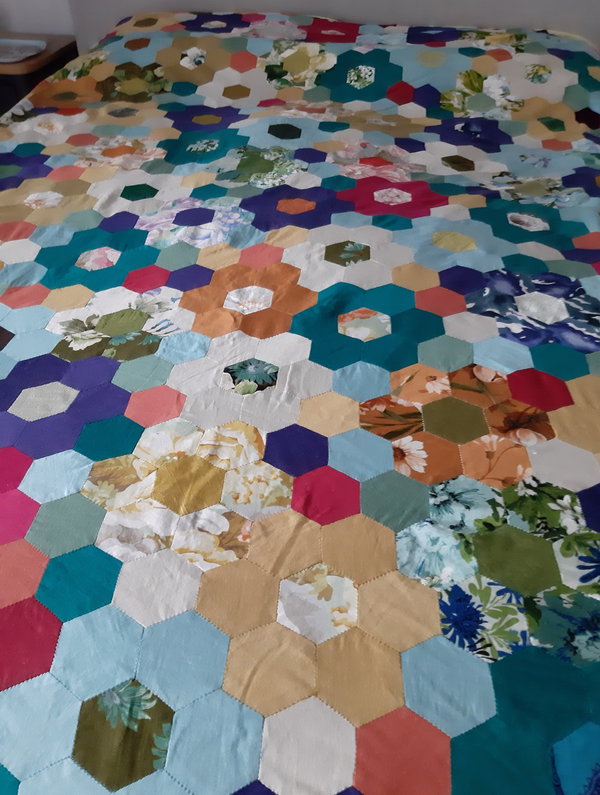
There is an echo from the past; her mother's beautifully stitched bedspread reminds us of a legacy of creativity, which in this house, runs in many directions.
Rosie mentions inspiration from her mother, but also from Graham, and from her daughter-in-law, Emily, from her sons Mungo and Ivan, and from her daughter, Victoria.
Rosie and Graham have three children, named, Mungo, Ivan, and Victoria. Rosie tells me that after giving birth to Victoria, the midwife quipped, "Now you have a Saint, a Czar, and a Queen, is it time to stop?"
Ivan lives in Bangkok. Rosie is delighted that he writes poetry too, and has set up a poetry/writing group ReadEasyBK. Participants read poetry to accompany old silent music. One film included a sea scene, and Ivan wrote a poem about fishermen to go with it. Graham put Ivan's words to music and turned it into a song (which we all enjoyed hearing at OUR Rothbury poetry and writing group).
Rosie manages to collect creative ideas from many places. From her family, from nature, from reading, observing, and thinking. She cleverly distills these ideas, and often synthesizes with other ideas.
The outcome is a house and garden of stunning simplicity, beauty, and serenity.
I am admiring a fluffy grass swaying outside the huge window 'Wind Dancer grass' Rosie tells me. 'It's had loads of babies, I will show you'. We go outside and she lifts up the skirt of soft grasses, I see baby ones nestled beneath.
Rosie then shows me the "Rill" - a term I had not come across before.
'We based on one we had seen at RHS Bridgewater where our daughter-in-law Emily volunteers at '.
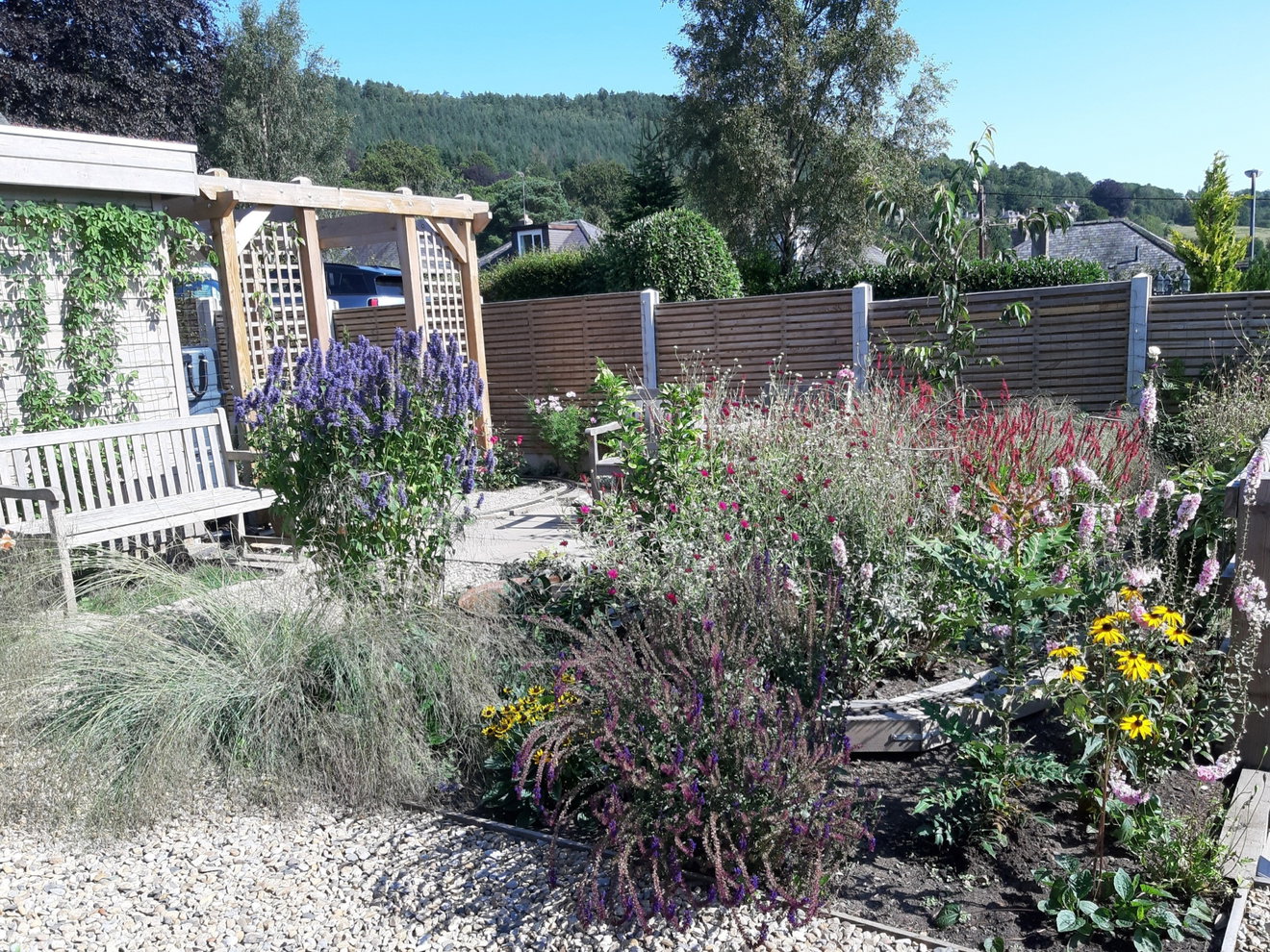
The garden is still a work-in-progress, but the vision is clear. With a Japanese influence, a summer house with a sedum roof, the garden embodies a desire to enhance biodiversity, with clean lines, bursts of colour and textures.
A lovely touch is the model railway which curves around the garden in a most entertaining way. This aspect is clearly Graham, and son Mungo's, creativity!
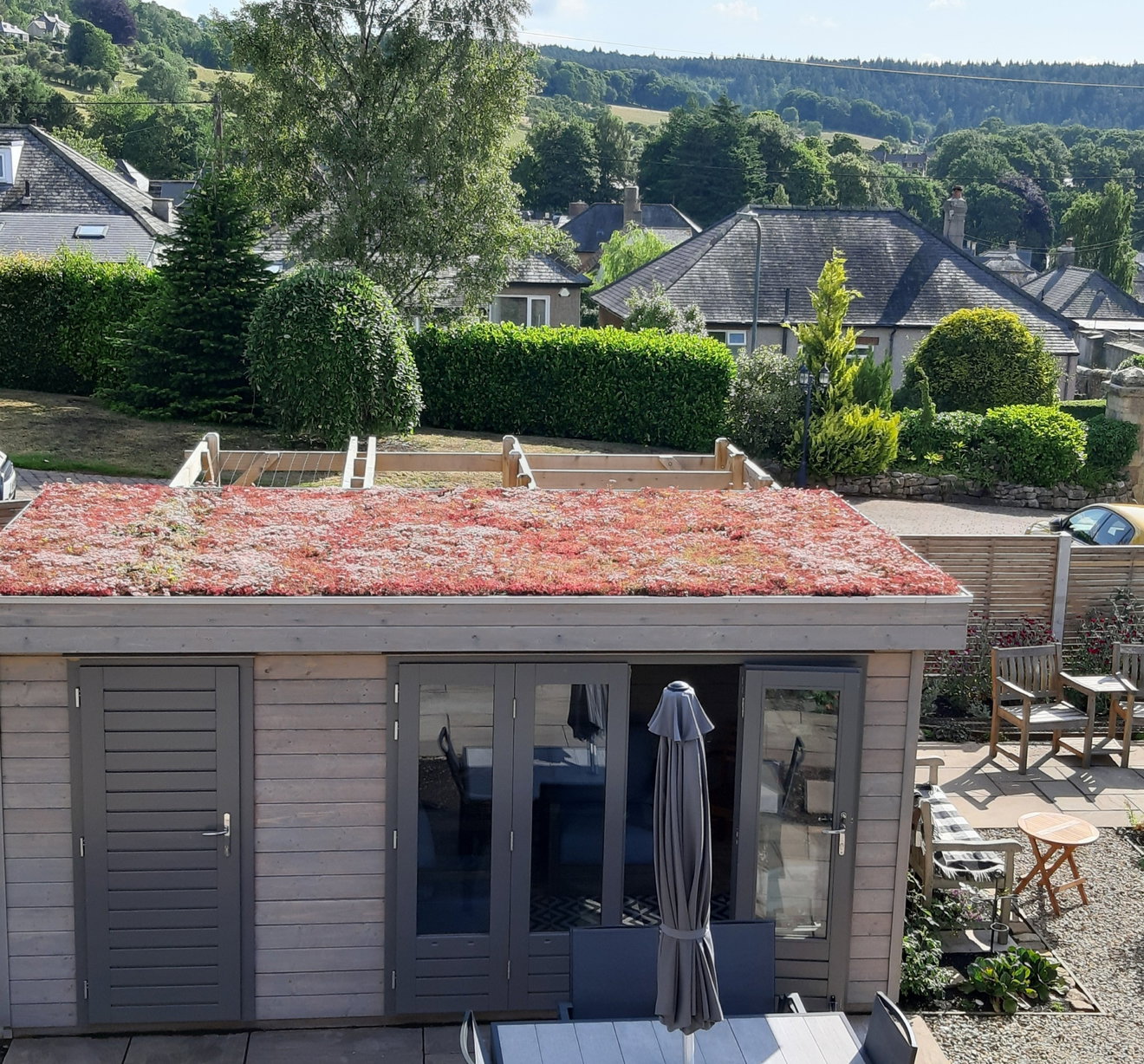
Sedam roof
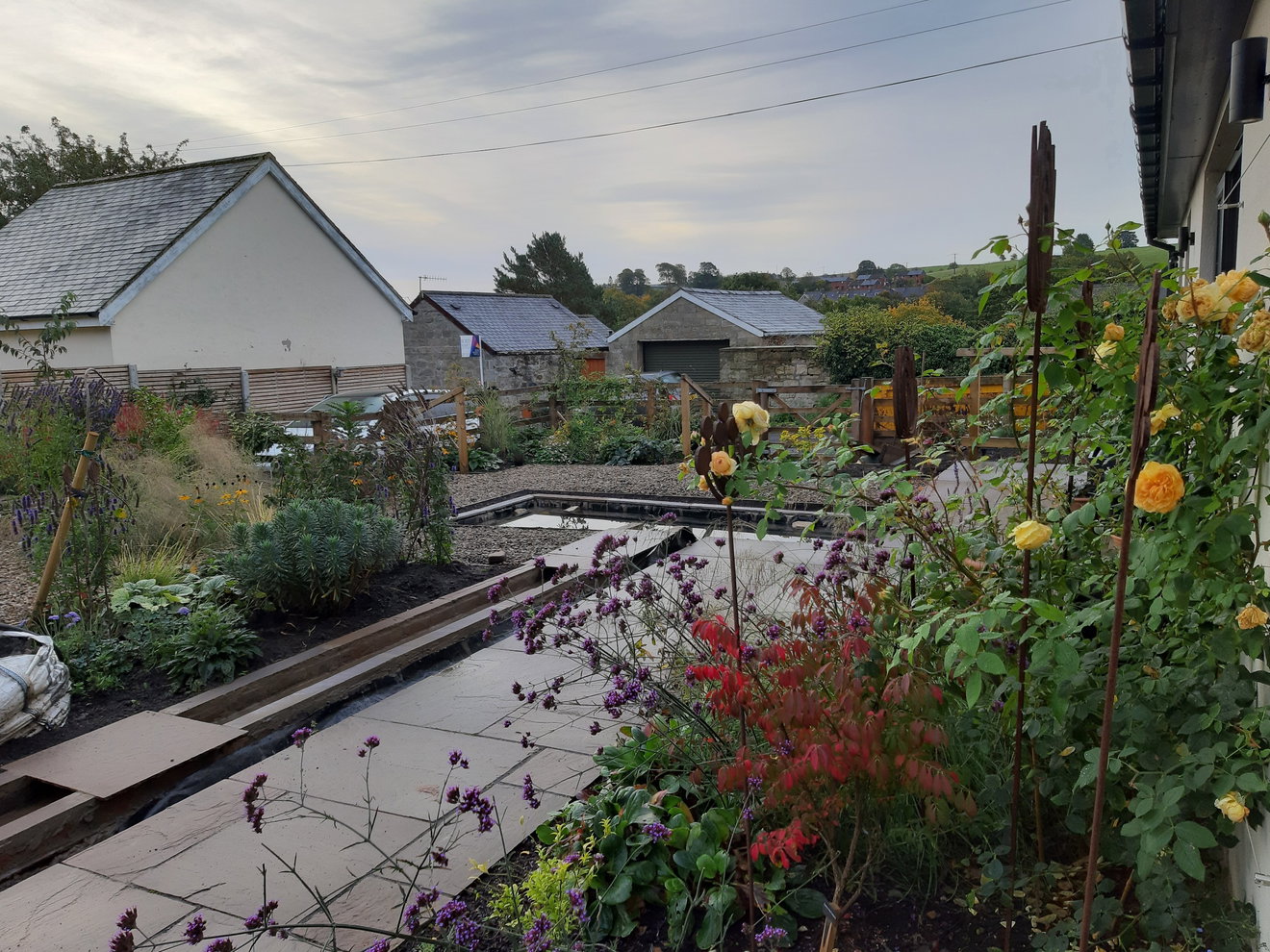
The rill, flowing into the pond.
What follows is the 2020 interview, but see after that, to find out What Happened Next.
Rosie Stacy
This is the interview from 2020:
Rosie is an extraordinary woman; a born educator and a great communicator who uses words thoughtfully. I've been struck by her writing when she reads poetry at an event which I host in Rothbury each month. I wanted to find out more about her.
Rosie and her family moved from Leicester to Nuthall, Nottinghamshire, for her father's teaching post at Eastwood Grammar School, when she was 8. She loved the large new garden: 'I was a mini Gerald Durrell, crawling around on the grass looking at beetles'. Her parents recognised and encouraged her love of nature and interest in science
Rosie's family was Christian, and in Nottingham they joined the Methodist church, where she was soon leading worship, giving her first sermon at 13 years of age.
I ask her what career path she considered.
'I always wanted to be a doctor. I used to read medical dictionaries for pleasure! However, I ended up studying biology at the University of East Anglia. I was in my element. It was an integrated degree, studying: biology, animals, genetics, DNA. It was such an exciting time'.
She was thrilled to find that the university choir was run by Sir Philip Ledger. Joining taught Rosie a great deal about singing. At university she met her husband, Graham Stacy. They, along with another friend, sang and played music, including to the residents of the local psychiatric hospital.
'The patients really came alive when we played'.
Rosie then completed a teaching certificate 'I loved it. I felt I was a born teacher'. For two years Rosie and Graham taught in Sierra Leone.
On returning to the UK, Rosie studied for a master's degree in Ecology, while Graham did a social work qualification. Moving to Morpeth in 1981, and having three children, changed the direction of Rosie's career.
After meeting a variety of inspirational women, she ended up researching adult education, including feminist courses, for her PhD.
She met Sandra Kerr, and joined Wercas folk Choir.
Rosie became a Research Associate, later Lecturer, at Newcastle University. All the things she had learned up to now seemed to coalesce into her new role. She was teaching doctors about inequalities in health; looking at the social determinants of well-being.
'My life has meandered; I've met and been engaged with experts in many fields. Music, singing and writing have always been important'.
After finding a house with a large garden, and drawn by the magnificent views, Rosie and Graham settled in Coquetdale, in 2001.
One day she had wonderful and extraordinary experience:
''I felt spoken to'.
Rosie started to go to church, first at Holystone, then at Alnwinton.
Then followed 'Discernment' which led to her becoming an Ordained Local Minister, licensed to her home parish.
'I felt this was my calling'.
Rosie exudes an aura of sincerity and kindness that we so need just now. She and Graham perform together as 'Chantry' and as part of a group called 'The Sturdy Beggars'. She sings in the Coquetdale Chamber Choir. Rosie writes poetry, which she often performs at the monthly Rothbury Poetry, Writing and Music event
What Happened Next
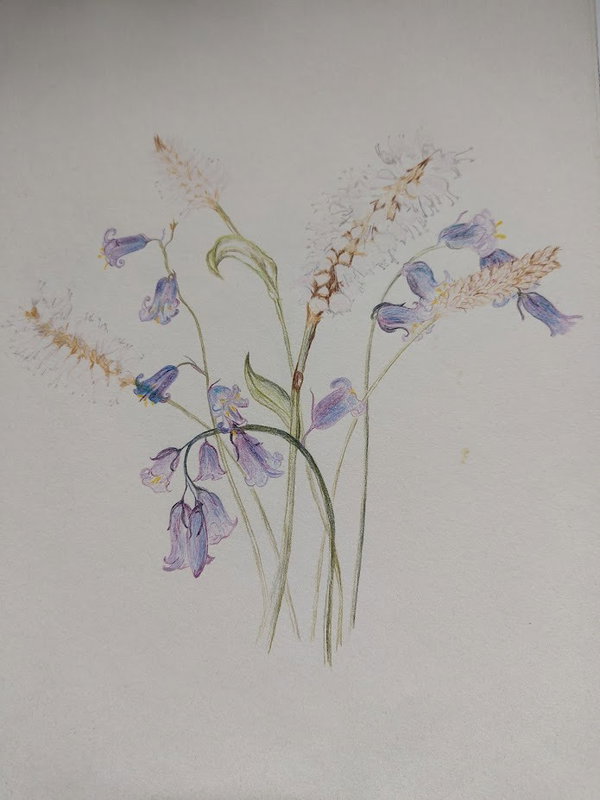
While having a look around Rosie and Graham's new house, I am admiring the artefacts from many different countries. But then I find a sketch pad of Rosie's with some exquisite botanical drawings. Rosie is a gifted artist, as well as writer of sermons, poetry, prose. A singer and musician, she has a great many talents.
Rosie has continued being part of The Sturdy Beggars.
"In historical English law, a sturdy beggar was a person who was fit and able to work, but begged or wandered for a living instead. The Statute of Cambridge 1388 was an early law which differentiated between sturdy beggars and the infirm poor... in 16th-century England, no distinction was made between vagrants and the jobless; both were simply categorised as "sturdy beggars", who were to be punished and moved on".
Wikipedia
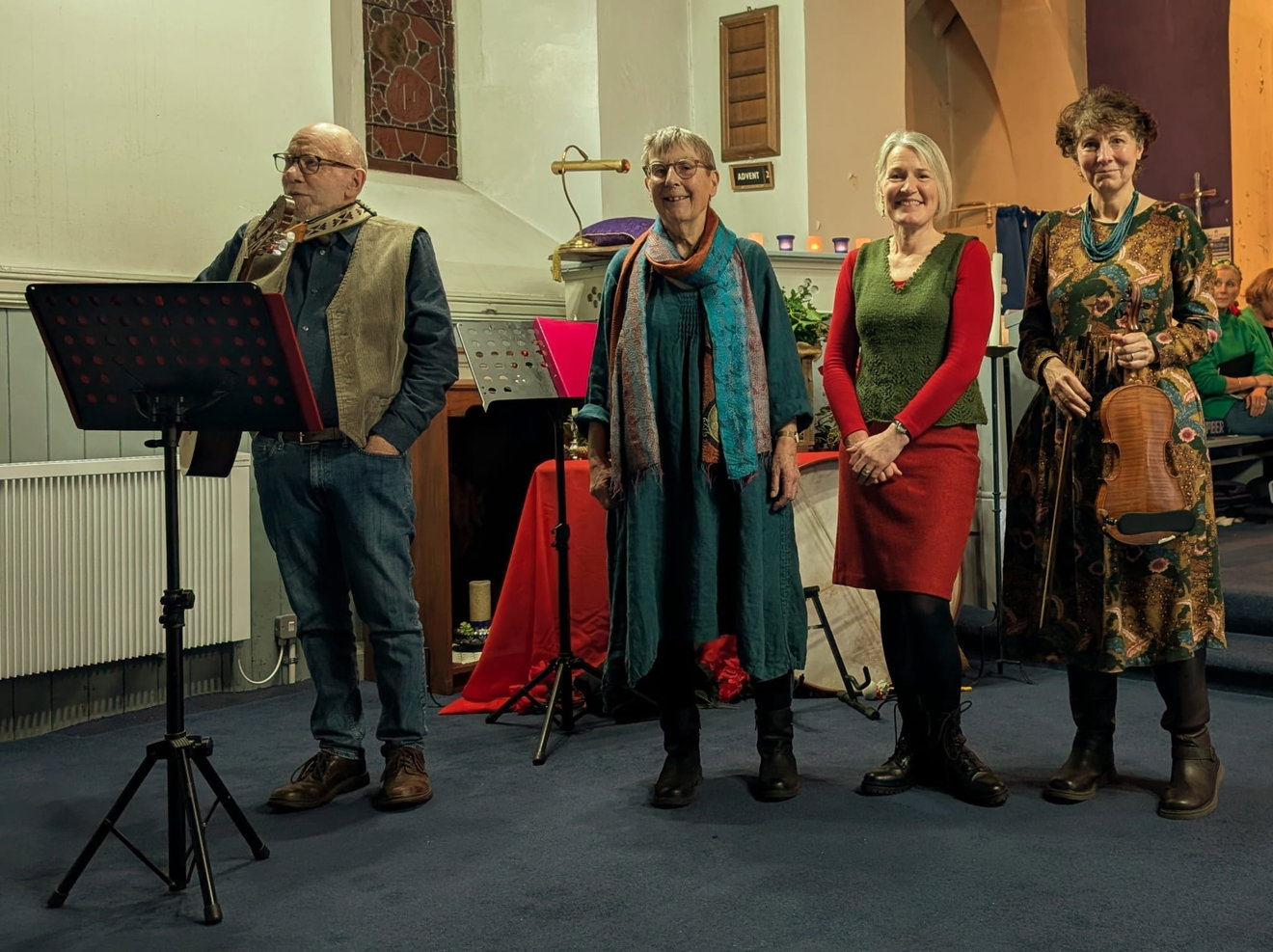
The Sturdy Beggars. Graham Stacy, Rosie Stacy, Jeanette Fielding and Sarah Husband.
Circle Dancing is also a creative activity that has been an important part of Rosie's life for a long time. She goes to Morpeth to take part in Circle Dancing twice a month, and she has helped set up a monthly group in Rothbury.
'One of her teachers, Judy King, is an international, and national, teacher. So the dances are excellent. We recently danced in Hexham Abbey, Under 'Gaia' (The Planet Earth).
Last year we danced there beside 12 huge embroidered panels, depicting the Creation Story'.
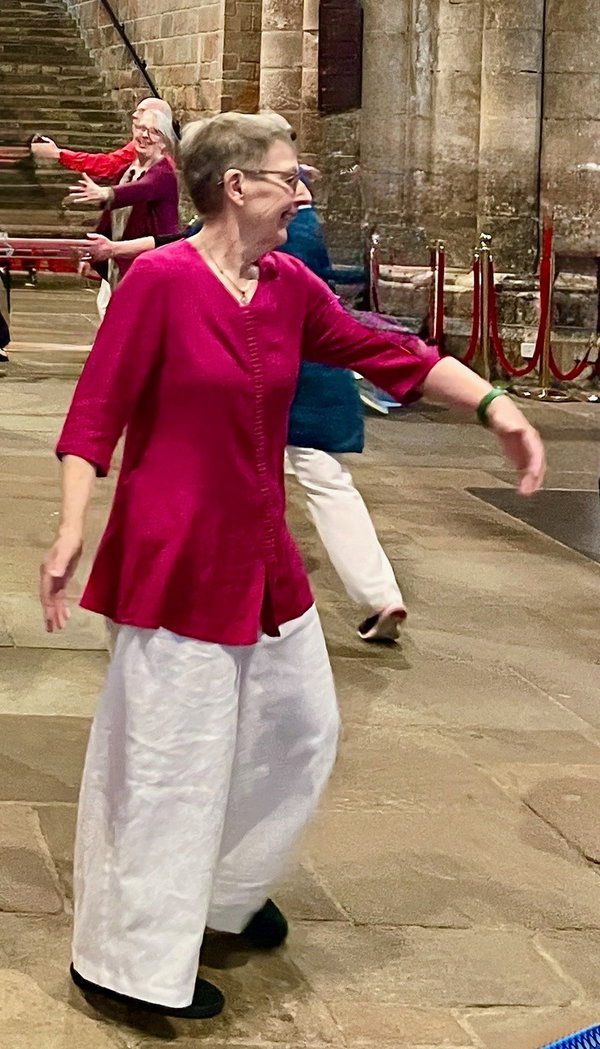
Rosie, taken by Judy King, at Hexham Abbey
I ask Rosie about her poetry. She often reads at the monthly Poetry, Writing, and Music Event, and many people have often wondered why she has not got at least one book of poetry published. 'Why have you not got any poetry or writing published'?
Rosie admits that she would like to pursue this, but is not sure how to go about it. We made a deal, in 2026 Rosie would find out, and think about, publishing.
I ask Rosie to choose a piece of prose for this article, you can read this at the end. 'I had this idea of a title for a collection, 'Prompted' - because almost all the things I have written, have had a specific prompt'.
'Have I missed anything?' I ask.
'Homemaking will continue' (by which she means adding details and creative ideas to the home). The garden will also continue taking my time: thinking, designing, planning and doing.
I also still do two Services a month. These are written by me, using specific Readings as prompts. I prepare these in a way to make them interesting and accessible.'
I know you will enjoy reading the following fine piece by Rosie. It is a response to the archaeological dig at Bamburgh, the finding of an early Christian cemetery in the dunes.
The Bamburgh Ossuary
Encaged and boxed, 110 of us, stacked, row upon row, layered and numbered. It was not meant to be like this: boxed bones.
Once, we were alive, and then, each at their own time, lowered into our sandy graves some 1400 years ago. We had the wind and the sea that we had had in life, and the tide washing in and out, in and out, day by day, over the years, shifting sand. Our burial site in the dunes below the great wooden castle became called the Bowl Hole.
A great storm roared; tugged and twitched our flagstone covers off; left some of us bare. And so we moved, moved with the shore; shuffled and became new shapes. I was the harp when they found me, my long bones angled, triangled, my ribs the strings. They lifted me gently up. They gathered my arms, my legs; laid me out, repositioned me; analysed, discussed; and renamed me. Baec-Bord.
The groove in my tooth suggested my occupation. I was a weaver, a needle worker. Thread held taut from mouth to hand. And the ischia of my pelvis confirmed 'weaver's bottom'. Hours of squatting, the radiating pain down my legs, the swelling and stiffness. I was still young. I died bearing my first child.
In life, I was a weaver of hopes and dreams when I came across the sea, and a weaver of threads through my work. It was in death that I could gather my notes into tunes, airs plucking the sky between this coast and my Irish homeland.
And now, here in this church crypt you gaze through the bars of this my cage. You will not see the ceremony when we were all brought in a horse drawn hearse from the castle with a procession of hundreds of people. You will not hear the Lord's Prayer being read in Old English as we were transferred to our final physical resting places.
You will not see inside my tidily stacked zinc box, boxed bones.
Go, go down through the dunes, go to the beach, look at the sea, feel
the sand in your toes and the wind in your face and look, look outside
the box.
Rosie Stacy
Get In Touch
If you would like to be interviewed for Coquetdale Creatives or have some news to share, then please let us know.
Contact Us